
Automation without curation is just high-speed spam. You've likely tried to get notified about deals only to end up with an inbox full of irrelevant marketing and expired codes. It's a waste of energy. You want the savings, but you don't want the digital clutter. We understand the frustration of finding a perfect lifetime deal only to realize the link died hours ago. You need a system, not a subscription to every generic newsletter on the web.
This article provides the blueprint for a streamlined, spam-free notification system. You'll learn how to automate your discovery process and secure verified, working codes before the general public even sees them. We'll move past the noise and focus on high-intent niche deals that actually matter to your workflow. Stop searching and start receiving expert-vetted results that arrive exactly when you need them. It's time to gain early access to the best offers without the headache of a messy inbox.
Key Takeaways
- Eliminate deal fatigue by shifting from manual hunting to automated discovery systems that value your time.
- Identify the critical difference between low-efficiency pull strategies and high-impact push notifications.
- Learn how to get notified about deals that are human-verified to bypass the frustration of expired codes.
- Follow a simple two-step audit to strip away marketing noise and build a high-signal notification hub.
- Gain early access to exclusive, tested discounts by prioritizing expert curation over flawed algorithmic bots.
Why You Need to Automate Your Deal Discovery in 2026
Manual hunting is dead. In 2026, time is the most expensive currency you own. Spending an hour to save twenty dollars isn't a win; it's a net loss. High-intent shoppers have abandoned the old ways of manual discovery. They rely on curated automation to get notified about deals before the limited-quantity offers vanish. Efficiency isn't just a preference. It's the only way to win in a market defined by scarcity and rapid-fire digital launches.
The evolution of deal discovery has been aggressive. We've moved from physical paper coupons to the sophisticated use of push technology. This shift allows for instantaneous communication. It removes the friction between a deal being posted and a consumer acting on it. If you aren't leveraging real-time alerts, you're competing against bots and professional scouts who are. You're essentially bringing a knife to a gunfight.
The Cost of Missing Out (COMO) on Digital Deals
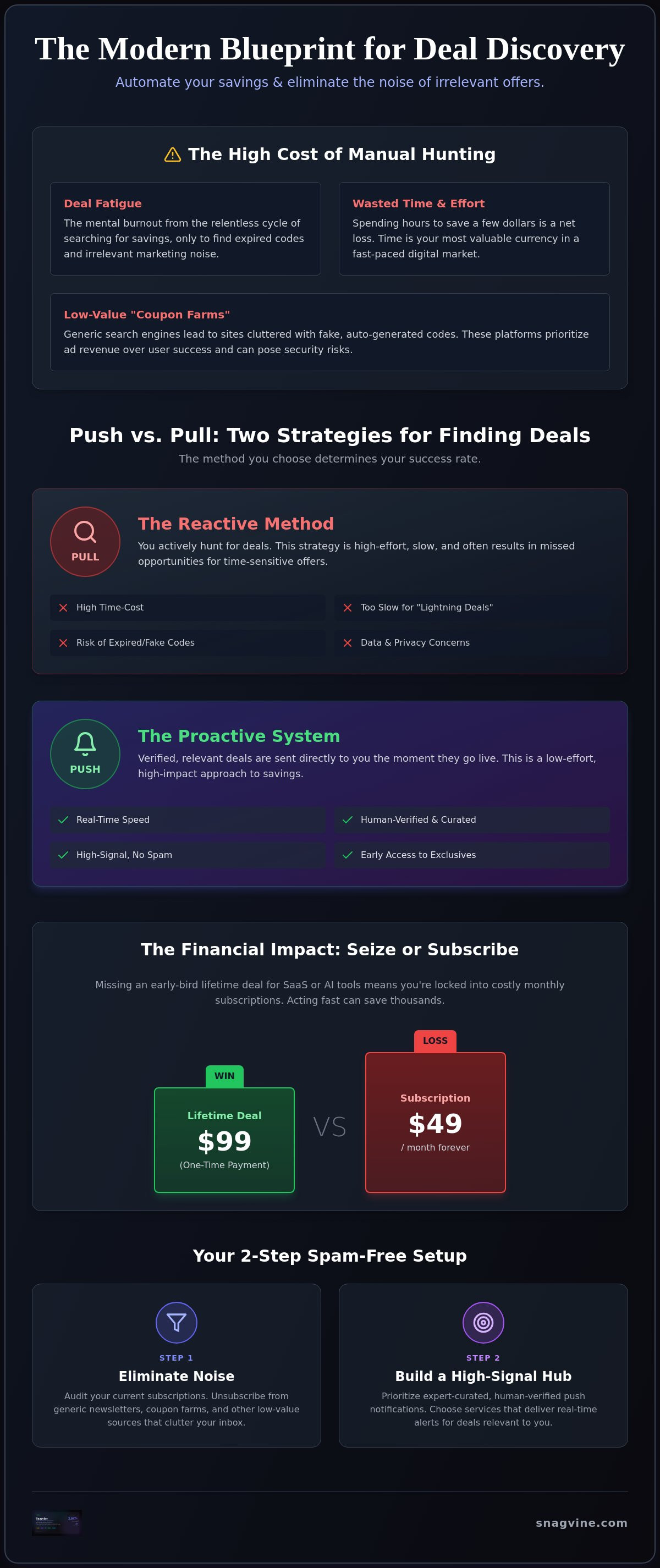
SaaS and AI developers frequently launch with "early bird" pricing tiers. These are high-stakes windows where the fastest users secure lifetime access for a fraction of the standard cost. The financial impact is stark. Missing a 90% lifetime deal means you're stuck with a recurring monthly subscription that drains your budget year after year. The difference between acting in minute one versus minute sixty can be thousands of dollars in long-term savings. This constant pressure to monitor the market creates a specific psychological burden. Deal Fatigue is the mental burnout caused by the relentless cycle of searching for savings only to be met with expired codes and irrelevant noise.
The Problem with Generic Search Engine Results
Traditional search engines are failing the modern shopper. A quick search for a brand's discount code usually leads to "coupon farms." These sites are cluttered with fake, auto-generated codes designed to bait clicks rather than provide value. They prioritize ad revenue over your success. They want your traffic, not your savings. It's a broken system that wastes your time and tests your patience.
Clicking unverified links on these platforms is also a security risk. Many serve as gateways for data harvesting or malware. This has triggered a massive shift toward trusted aggregators and curated lists. Savvy users no longer trust the algorithm. They trust human scouts who verify every code before it's published. You need a system that acts as a decisive filter. It should protect your time and your data while delivering the savings you actually want. This is how you reclaim your schedule and your inbox.
The Mechanics of Deal Notifications: Push vs. Pull Strategies
Efficiency requires a strategic choice between two methodologies: push and pull. Pull strategies are reactive. You check a bookmark or wait for a browser extension to trigger at checkout. It's too slow. Push strategies are proactive. Information finds you. This is the professional standard for anyone looking to get notified about deals in high-competition niches like SaaS or finance. You don't hunt for the signal; you build the receiver.
In the digital economy, timing isn't just a factor. It is the only factor. The most lucrative offers are often "lightning" deals or limited-seat lifetime licenses. These frequently sell out within a 15-minute window. If you aren't using push technology, you've already lost. Professionals use Webhooks and RSS feeds to bridge the gap between a price drop and a purchase. They don't wait for a weekly digest. They act on the immediate signal.
Browser Extensions: The Passive Pull Method
Browser extensions like Honey or Capital One Shopping offer a passive pull experience. They scan for codes only when you're already on the checkout page. This is fine for generic retail, but it fails for exclusive, non-public codes. There's also a significant privacy trade-off. These tools often track your entire browsing history to build a consumer profile. Practicing safe online shopping means being critical of what data you share with these "free" tools. They aren't scouts. They're data aggregators that only trigger after you've already done the hard work of finding the product.
Real-Time Alerts: The Aggressive Push Method
Aggressive push methods include SMS alerts and curated newsletters. These bypass the browser entirely. SMS is the fastest, boasting near-instant open rates. However, a high-quality deal alert newsletter provides the context and verification that a text message lacks. It allows you to see the logic behind the discount. You can also set up browser-level push notifications for specific directories. This creates a dedicated lane for savings that doesn't clutter your personal communication channels. It's about building a system that serves you. Choosing how to get notified about deals determines whether you save money or just waste your afternoon.
Beyond the Browser Extension: Why Curated Alerts Beat Algorithms
Algorithms are built for scale, not accuracy. They scrape the web for any mention of a discount and push it to your phone. The result is a flood of low-value noise. When you want to get notified about deals, you aren't looking for a thousand random notifications. You're looking for the three or four opportunities that align with your specific interests. Aggregation is a numbers game. Curation is a quality game. It's the difference between a cluttered inbox and a tactical advantage.
The algorithmic flaw is obvious: bots can't test a checkout process. They promote "zombie" deals that have been dead for months because those pages still rank well in search. Manual verification is the only way to guarantee a code actually works. It's the human element that transforms a list of possibilities into a list of certainties. Snagvine operates on a strict "No-Spam" philosophy. We only send an alert when the value is significant and the code is verified. If it doesn't save you substantial time or money, it doesn't make the cut.
The Fake Code Epidemic
Coupon farms thrive on your frustration. They keep expired codes live to maintain their SEO rankings. Every click you make on a dead code is revenue for them, even if you leave empty-handed. It's a waste of your energy. Identifying a click-bait deal is easy once you know what to look for. Look for "reveal" buttons that lead to generic landing pages or codes that appear on fifty different sites simultaneously without a verification timestamp. The Snagvine Standard is our internal benchmark for reliability: every single deal is researched, tested, and manually verified by our team before it hits your inbox. Just as you might rely on FTC Consumer Alerts to stay ahead of digital scams, you need a dedicated scout to filter the commerce noise.
Niche Expertise in AI and Fitness Gear
Generic trackers are fundamentally incapable of monitoring specialized industries. They miss the "early bird" windows for new AI startups and the limited-run drops for high-end fitness equipment like REP Fitness. These deals don't happen on Amazon. They happen in niche circles and affiliate networks. Curated alerts provide the context that a bot lacks. We don't just tell you there's a discount. We tell you it's the lowest price in two years. This level of "Insider Access" is essential for high-intent shoppers. You don't just get notified about deals; you receive a tactical advantage. You act on verified intelligence, not algorithmic guesswork. It's about moving faster than the crowd.
How to Set Up a Spam-Free Alert System
Building a system to get notified about deals requires a shift from passive consumption to active filtering. Most shoppers make the mistake of subscribing to every brand they've ever bought from. This creates a wall of noise that obscures actual value. You don't need more emails; you need better ones. Follow this five-step blueprint to build a receiver that only triggers when a high-intent opportunity arises.
- Step 1: The Audit. Unsubscribe from brand-direct marketing. These emails are designed for engagement, not savings. They're fluff.
- Step 2: The Hub. Select a primary discovery hub. For tech, finance, and fitness, use a curated directory that does the verification for you.
- Step 3: The Alias. Create a dedicated email alias or a nested folder. This keeps your primary workspace clean and organized.
- Step 4: The Triage. Enable mobile push notifications only for "Tier 1" sources. If a deal is time-sensitive, you need it on your lock screen.
- Step 5: The Tool Split. Use automated price trackers for physical hardware. Use curated alerts for software and SaaS where "lightning" lifetime deals are the goal.
Managing Your Inbox for Maximum Efficiency
Efficiency is found in automation. Set up Gmail filters to automatically label incoming alerts based on keywords like "Lifetime Deal" or "Exclusive." This allows you to scan your deals folder in seconds without getting distracted. Decide on your rhythm. A "Once-a-Day" digest is perfect for lifestyle items. However, "Real-Time" alerts are mandatory if you want to get notified about deals in the AI or SaaS space before they sell out. Use tools like Unroll.me to mass-unsubscribe from the legacy noise you missed during your initial audit.
Privacy-First Deal Hunting
Protect your digital footprint. Use "Burner" or masked emails for one-time discount codes to prevent your primary address from being sold to data brokers. Many deal links contain heavy tracking parameters. You can often bypass these by stripping everything after the question mark in a URL. This is why a curated deal alert newsletter is superior to a browser extension. Extensions often act as history trackers. A newsletter is a simple, one-way delivery of verified intelligence. It's the safer, cleaner way to secure early access without the privacy trade-off.
The Snagvine Advantage: Real-Time Alerts for Verified Savings
Snagvine acts as your professional intermediary. We don't just aggregate; we curate. Most platforms flood your notifications with every minor price drop. We don't. Our system is designed to get notified about deals that represent significant, vetted value. It's about signal, not volume. We position ourselves as the decisive filter between you and the noise of the digital marketplace. You don't need a thousand alerts. You need the right ones.
Our team manually tests every single code. We simulate the checkout process to ensure the discount is active and the terms are transparent. We ignore the "zombie" deals that clutter generic coupon sites. If a code fails our internal audit, it never reaches your inbox. This level of diligence saves you from the frustration of expired links and fake promises. It turns your inbox from a source of stress into a tactical asset.
Editorial independence is our foundation. We aren't a clearinghouse for every brand on the web. We prioritize tools and gear we actually use in our own workflows across the AI, fitness, and finance sectors. This creates a circle of trust. You aren't just getting a code; you're getting a recommendation from a knowledgeable peer who has already performed the necessary due diligence. We value your time because we value our own.
Exclusive Codes You Wont Find on Google
Google search results are cluttered with "found" codes that rarely work. We secure direct-from-vendor discounts through established industry relationships. These are exclusive. They are stable. They don't disappear because of a bot-driven surge. You can check our Master Directory for current verified codes to see the difference curation makes. Reliability is our primary metric. We focus on high-impact savings that move the needle on your budget, especially for limited-run tech bonuses where speed is essential.
Start Saving Today
Joining our system is frictionless. We don't want your data; we want to save your time. There are no complex forms or credit card requirements. Expect your first alert to be a direct hit of utility with zero fluff. You'll get notified about deals that align with your interests the moment they are verified. Stop fighting the noise and start using a system built for high-intent efficiency. Join Snagvine for Free Deal Alerts and start winning the savings game today.
Master Your Digital Deal Strategy
Manual hunting is a relic. You now have the blueprint to build a decisive filter that protects your time and your budget. Shifting from reactive pull methods to proactive push strategies ensures the best opportunities find you first. Human curation beats algorithmic guesswork every time. It's the only way to guarantee you never waste another minute on a "zombie" code or a click-bait landing page. Implement the system and stop the search.
The smartest way to get notified about deals is through a dedicated receiver that values accuracy over volume. Use these techniques to reclaim your inbox from brand-direct noise. You don't need more clutter. You need verified results that move the needle on your efficiency. Secure your spot in the early-access window for high-value AI and tech drops before they expire. Expert scouts do the hard work so you don't have to.
Get Notified About the Best Verified Deals: Join Snagvine for Free. Benefit from our 100% verified codes, early access to AI and tech savings, and our strict no-spam guarantee. It's time to automate your savings and focus on your actual work. Start today and experience the relief of a truly streamlined discovery system.
Frequently Asked Questions
How do I get notified about deals on specific products?
Use a combination of automated price trackers for hardware and curated newsletters for software. For physical goods, tools like CamelCamelCamel or Keepa monitor specific SKUs effectively. For specialized software or fitness gear, a dedicated directory provides better coverage of non-public codes. Setting up browser-level push notifications for these sources ensures you receive alerts the moment a price drop is verified by a human scout.
What is the best way to track price drops on Amazon?
Dedicated tracking tools like CamelCamelCamel or the Keepa browser extension are the industry standard. These services monitor price history and send email or browser alerts when an item hits your target price. Avoid relying on the Amazon app's native notifications alone. They often lack the historical context needed to identify a genuine lowest price versus a temporary, minor fluctuation.
Are deal alert newsletters safe to subscribe to?
Yes, provided they have a transparent privacy policy and a clear no-spam guarantee. Curated newsletters are generally safer than browser extensions because they don't track your cross-site browsing history. To get notified about deals securely, verify that the service doesn't sell your data to third parties. Using a dedicated email alias adds an extra layer of protection for your primary inbox.
How can I stop getting spam while still receiving deal alerts?
Audit your current subscriptions and move to a curated hub model. Unsubscribe from brand-direct marketing that fills your inbox with fluff and irrelevant promotions. Instead, subscribe to a single, trusted directory that filters the market for you. This allows you to receive only high-value, verified notifications while keeping your main communication channels clear of the traditional marketing noise.
Why do most discount codes I find online not work?
Most coupon sites use automated bots to scrape the web for any mention of a code. They often keep expired ones live to boost their search engine rankings and bait clicks. These "zombie" codes are never tested by humans. Curated sites solve this by manually verifying every discount at the checkout page. If a code isn't human-verified, there's a high probability it won't work.
Can I get notified about software lifetime deals (LTDs)?
Yes, and this is where curation is most valuable. Software lifetime deals are often limited-quantity and expire within hours or days. To get notified about deals in the SaaS and AI space, join a specialized alert system that focuses on these niches. Real-time push notifications are essential here. Waiting for a weekly digest usually means missing the "early bird" pricing window entirely.
What is the difference between a deal aggregator and a curated deal site?
Aggregators prioritize volume, using bots to pull thousands of random discounts from across the web. Curated sites prioritize quality, using human scouts to filter for significant savings and verified functionality. An aggregator gives you noise; a curated site gives you a signal. You save more time by looking at ten "must-have" deals than by sifting through a thousand unverified links that may not work.
How often should I expect notifications from a deal alert service?
Frequency depends on the service's philosophy, but a high-quality provider only triggers alerts when the value is substantial. Expect real-time notifications for time-sensitive "lightning" deals and perhaps a daily or weekly digest for broader market trends. If a service sends multiple alerts per day for minor discounts, it's likely contributing to deal fatigue. A professional system values your time above all else.